
A heated hoodie blanket needs the power supply specified on its care label, electrical label, or instruction sheet—not simply a charger whose plug fits. Match the required voltage, current, connector, and any stated charging protocol before connecting it. A wall adapter, power bank, or replacement battery is suitable only when the hoodie’s instructions explicitly support that source.
- A heated hoodie blanket needs a power source that matches its electrical label and manufacturer’s instructions.
- USB connectors alone do not establish charger or power bank compatibility.
- Ohhthatsgood lists a Heated Hoodie Blanket; check its power requirements before choosing an adapter.
- For portable warmth, confirm battery compatibility and permitted use rather than assuming any power bank works.
Why this matters
The wrong power source can leave your hoodie unheated, cause repeated shutdowns, or create an electrical hazard. Choosing by connector shape skips the information that actually determines compatibility.
If you are considering the Ohhthatsgood heated hoodie blanket, check the garment’s instructions before pairing it with an adapter you already own. Buy for your intended use, then verify the complete power connection. That is the useful distinction when comparing wearable warmth products in 2026.
What power supply does a heated hoodie blanket need?
A heated hoodie blanket needs a source whose output meets the garment’s stated input requirements. Start with the garment, not the charger drawer: the electrical label determines what you can connect.
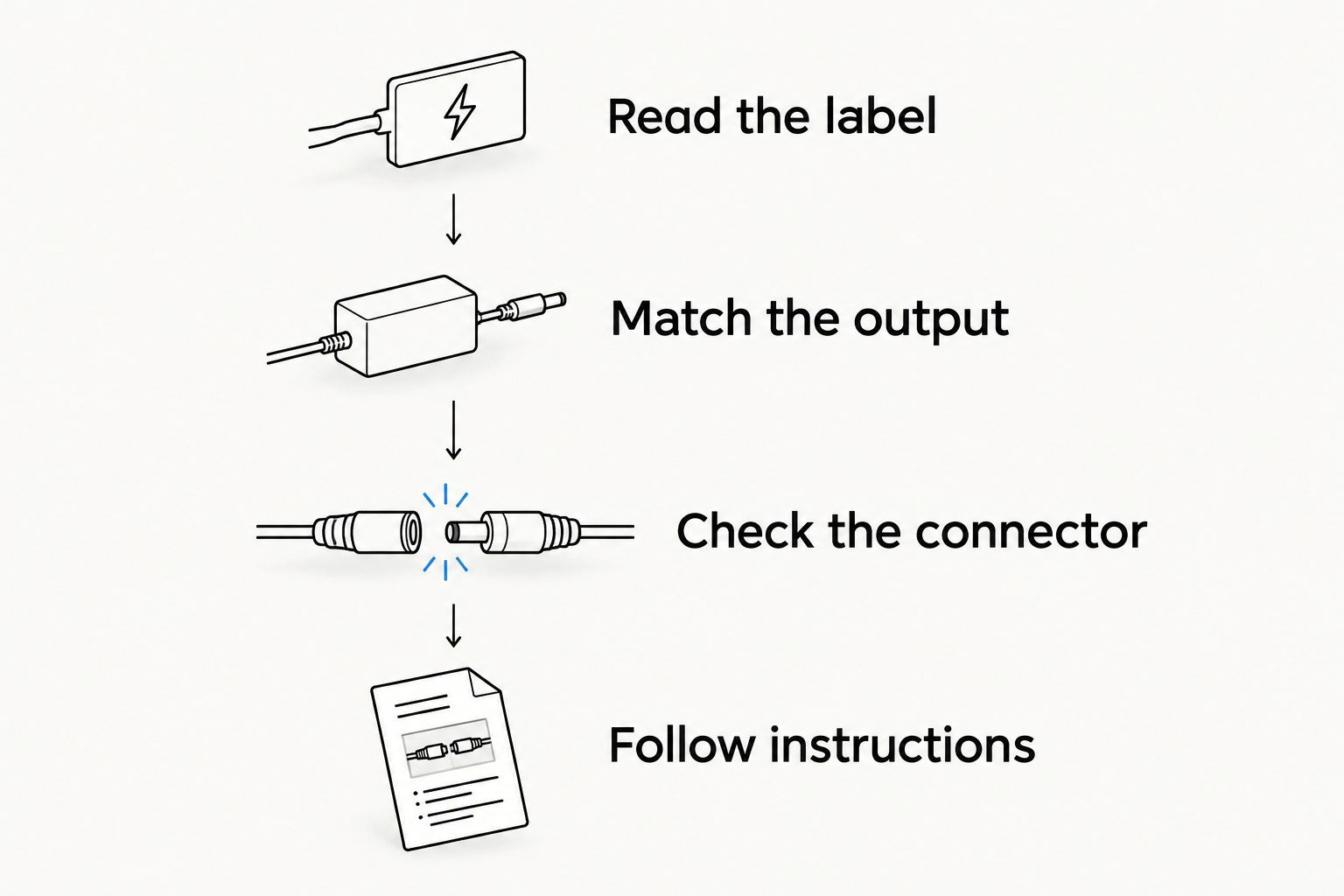
Use this sequence before powering it:
- Read the label. Find the required input voltage, current or wattage, and any instructions identifying a particular adapter or battery.
- Match the output. Compare those requirements with the adapter’s output information, not just its household electricity input.
- Check the connector. Confirm the connector type and, where applicable, polarity and charging protocol.
- Follow instructions. Use the supplied controller, cable, and power source in the arrangement the manufacturer describes.
Do not substitute a power source when the instructions call for a specific battery or adapter. A physically matching connector is not permission to use it.
Which type of power source should you check?
The following comparison describes possible power arrangements, not confirmed specifications for a particular hoodie. Use only the arrangement named in your garment’s instructions.
| Power source | Best for | Practical advantage | Limitation |
|---|---|---|---|
| Manufacturer-specified wall adapter | Seated use near an outlet | Does not depend on a portable battery’s remaining charge | Keeps you connected to an outlet |
| Compatible USB power bank, when permitted | Moving around without a wall connection | Provides portable power | Output requirements and supported connections must match |
| Manufacturer-specified battery pack | Garments designed around a particular battery | Matches the intended battery connection | A different pack is not automatically interchangeable |
Choose the approved power arrangement, not the most convenient-looking plug. In 2026, USB connector shape still does not tell you every electrical feature a device requires.
Using a wall adapter: read output, not just input
A wall adapter has two different jobs: accepting household electricity and supplying the electrical output your garment uses. The input and output labels describe different sides of that process.
In the United States, standard household power is nominally 120 volts at 60 hertz. Those figures describe the wall supply; they are not an instruction to connect a hoodie’s low-voltage heating cable directly to household electricity.
For an adapter-powered garment, compare the hoodie’s input requirements with the adapter’s output rating. Follow any manufacturer restriction on replacement adapters, even when another unit appears to have matching numbers.
Best for: using a heated garment while seated near a suitable outlet. The limitation is the cable: arrange it so it does not pull on the garment connector, cross a walking route, or become pinched by furniture.
Before standing up, disconnect as the instructions direct. Do not use the garment cable to pull an adapter out of a socket, and do not improvise an extension inside the hoodie to gain extra reach.
Using a USB power bank: confirm that portable power is supported
A USB power bank is an option only if the heated hoodie blanket is designed to use one. A USB-shaped connection is not enough evidence on its own.
Check the output associated with the particular port you plan to use. A power bank with several ports can list different output capabilities for different connections, so read the labeling and instructions for the selected port and cable.
Best for: portable use when the garment explicitly supports a compatible power bank. The trade-off is that you must carry the battery and manage its remaining charge, cable, and placement according to the instructions.
Do not select a power bank solely by its capacity claim. Capacity does not establish the correct voltage, sufficient output, or a supported charging protocol.
For a 2026 purchase, make the portability question specific: “Does this garment support the power bank and cable I intend to use?” That question is more useful than asking whether it is simply USB-powered.
Using a dedicated battery: match the specified pack
If the garment instructions identify a dedicated battery, use that specified battery or an explicitly approved replacement. Connector fit alone does not establish battery compatibility.
Battery packs can differ in output, connector wiring, and control arrangements. Do not move a battery between unrelated heated products because both products are wearable or both connectors look alike.
Best for: a hoodie designed around its own battery system. The limitation is replacement flexibility: you must follow the garment’s battery requirements rather than choose an unrelated pack from a drawer.
Keep the battery and its charging equipment together with the instructions. If a replacement is needed, identify it from the documented model information rather than from appearance alone.
Why heated hoodie blanket power requirements vary
Power requirements follow the garment’s electrical design. These are the factors to check, rather than assumptions to make from photographs or product names:
- Input voltage: The garment’s required voltage must match the supported source output. A higher voltage is not an upgrade.
- Current or wattage requirement: The source must provide the required output under the conditions stated by the manufacturer.
- Connector and polarity: A connector can fit mechanically without being electrically compatible. Follow any polarity marking and specified connection type.
- Power protocol: Where a garment requires a particular USB power arrangement, the source and cable must support it.
- Controller and cable: Keep the intended components together. A replacement cable or controller needs explicit compatibility, not just a matching end.
- Approved operating arrangement: Instructions determine whether the garment uses wall power, a portable source, or a dedicated battery, and whether operation during charging is permitted.
These checks also explain why another heated product’s adapter is not a reliable substitute. A heated throw and a wearable blanket can serve similar comfort needs without sharing electrical requirements.
How do you read volts, amps, and watts?
Volts describe electrical potential, amps describe current, and watts describe power. Read the units carefully when comparing labels; similar-looking numbers with different units are not equivalent.
1 amp equals 1,000 milliamps. That conversion helps when one label uses A and another uses mA, but it does not settle voltage, connector, polarity, or protocol compatibility.
For direct-current output, watts equal volts multiplied by amps. Use the relationship to understand a label, not to invent a power requirement for a garment whose instructions specify a particular source.
An adapter’s maximum current rating is its capacity, not a command to force that current through the garment. Still, a higher current rating alone does not approve the adapter: the voltage, connection, protocol, and manufacturer’s requirements must also match.
Can you use a phone charger for a heated hoodie blanket?
A phone charger is suitable only when the hoodie’s instructions allow that type of source and the charger supplies the required output through a compatible cable. “It charges my phone” is not a compatibility check.
Read the charger’s output information and the garment’s input information together. Do not choose an adapter by its advertised maximum wattage alone, especially when its label lists several possible outputs.
Does a heated hoodie blanket need to stay plugged in?
A heated hoodie blanket needs its supported power source connected while its electric heating operates, unless its documented design says otherwise. A battery-powered arrangement removes the wall connection, not the need for an electrical source.
The fabric remains wearable without active heating, but do not treat that as evidence of how long warmth will last. Choose between tethered and portable use based on the garment’s actual power instructions.
Which blanket style fits your evenings at home?
The Ohhthatsgood heated hoodie blanket is best for shoppers seeking wearable warmth rather than a separate throw. Choose it for that format, then confirm that its documented power arrangement fits where you plan to sit or move.
A conventional heated blanket is the alternative when you want a covering rather than a garment. The Ohhthatsgood catalog includes both formats; their names do not establish that their adapters, controllers, or batteries are interchangeable.
| Product | Best for | Useful distinction | Practical limitation |
|---|---|---|---|
| Heated Hoodie Blanket | Shoppers who want wearable warmth | Hoodie blanket format | Check fit and power requirements before choosing |
| 3-Level Safety Heated Blanket with Adjustable Temperature | Shoppers who prefer a separate blanket | Listed as a 50 × 60-inch, double-sided flannel blanket | It is a covering rather than a hoodie; verify its own electrical instructions |
The separate blanket’s documented 50 × 60-inch dimensions give you a concrete sizing check. Measure the area you want to cover rather than assuming a throw will fit like a wearable blanket.


What should you check before switching the heat on?
For your first use in 2026, inspect the complete connection rather than testing whether an unknown adapter happens to work. Keep the instructions nearby until you know the correct setup.
- Check the cable, connector, controller, and power source for visible damage.
- Confirm that the electrical labels and approved components match.
- Make sure connections are dry and positioned as directed.
- Arrange the cable without tension, pinching, or a trip hazard.
- Follow the garment’s operating, charging, cleaning, and storage instructions separately.
Stop using the product if you notice damaged wiring, an unusual smell, discoloration, or abnormal heating around a connection. Disconnect it safely and follow the manufacturer’s support instructions; do not try different adapters to work around the symptom.
FAQ
What power supply does a heated hoodie blanket need?
A heated hoodie blanket needs the supply specified by its electrical label and instructions. Match voltage, required output, connector, and any stated power protocol before use.
Can I plug a heated hoodie blanket into any USB port?
No, a USB connector alone does not establish compatibility. Use only a source and cable that meet the garment’s documented requirements.
Can I use a power bank with a heated hoodie blanket?
Use a power bank only if the heated hoodie blanket’s instructions support it. Check the particular output port and cable, not just the battery’s capacity.
Does a higher-wattage charger make a heated hoodie blanket warmer?
A higher-wattage charger is not a method for increasing a heated hoodie blanket’s temperature. Use the specified power source and the garment’s intended heat controls.
Can I use another heated blanket’s adapter?
Do not use another heated blanket’s adapter unless it is explicitly approved for your garment. Similar connectors and product names do not establish electrical compatibility.
Can I wear a heated hoodie blanket while its battery charges?
Wear it during charging only if the manufacturer explicitly permits that arrangement. Instructions for charging a battery do not automatically authorize operating the garment at the same time.
What should I check when buying a heated hoodie blanket in 2026?
Check the power requirements, supported source, included components, fit, and operating instructions before buying a heated hoodie blanket in 2026. Choose the wearable format only if its approved setup fits your intended use.
One last thing
Photograph the garment’s electrical label and the approved power source’s output label before putting the packaging away. Store those photos with the instructions so a future replacement starts with the right information.
A plug that fits is only a mechanical match. The electrical match is what determines whether you should use it.